
Reuse the world you have already built
Reuse compatible scene foundations and send compact descriptions of what changes. Reconstruct the content required for an interaction instead of repeatedly carrying its expanded form.
COMPACT INTERACTIVE WORLDS
Build rich interactive places from compact seeds, distinctive animated creatures and reusable world foundations. Expanding Worlds explores linked and nested environments that preserve accepted changes and reconstruct requested detail for the next view or interaction.
Working game and 3D demonstrations · technical evaluation by agreement
UK application GB2625572.9 · Pending · Filed 27 October 2026
04 / WORLD
Expanding WorldsSHARED FOUNDATIONS · CHANGING WORLDSWATCH THE INTRODUCTION
Product chapter from the BBF portfolio introduction.
00:01:52–00:02:45 in the eight-technology introduction · Narrated by Aeternum. Read the portfolio transcript →
This scene preview stops at the end of the selected chapter. Open the video library to watch from a scene onwards.
WHY IT MATTERS
Reuse compatible scene foundations and send compact descriptions of what changes. Reconstruct the content required for an interaction instead of repeatedly carrying its expanded form.
Build variety into creatures, objects and encounters while reusing the structures they have in common.
Retain world identities and selected history, then check that reconstructed state matches the expected scene.
COMPACT CONTENT · EXACT COMPARED FRAMES
Rich scenes can be described without sending every expanded detail again. In the recorded compatible-content study, the receiver reused its existing runtime and assets to reconstruct the requested content.
About 1,150 expanded-content bytes represented per packet byte. Across eight six-frame sessions, compact packets described content that the compatible receiver could reconstruct. This is byte avoidance: reuse available structure instead of repeatedly carrying its expanded form.
The shared runtime, libraries and assets were already present and are outside these packet sizes. The expanded-content basis includes frames and inherited source content. These figures measure content representation, separately from total installation size, runtime memory, physical line speed and frame rate.
Against the independent compact stream in the same study, 462 B versus 3,117 B was an 85.18% packet reduction.
Explore the original comparison and complete-cost context →HOW YOU COULD USE IT
Move between linked places, revisit a scene or interact with a creature. Reuse the shared foundations and reconstruct the required state. Earlier prototypes include a 13-zone nested-world inspector with six linked-world controls and a recorded local character-action route that completed without waking the whole world.
PORTFOLIO INTRODUCTION
Discover how our eight technologies address AI workflows, data, graphics, interactive worlds and learning.
BUILT WITH BBF
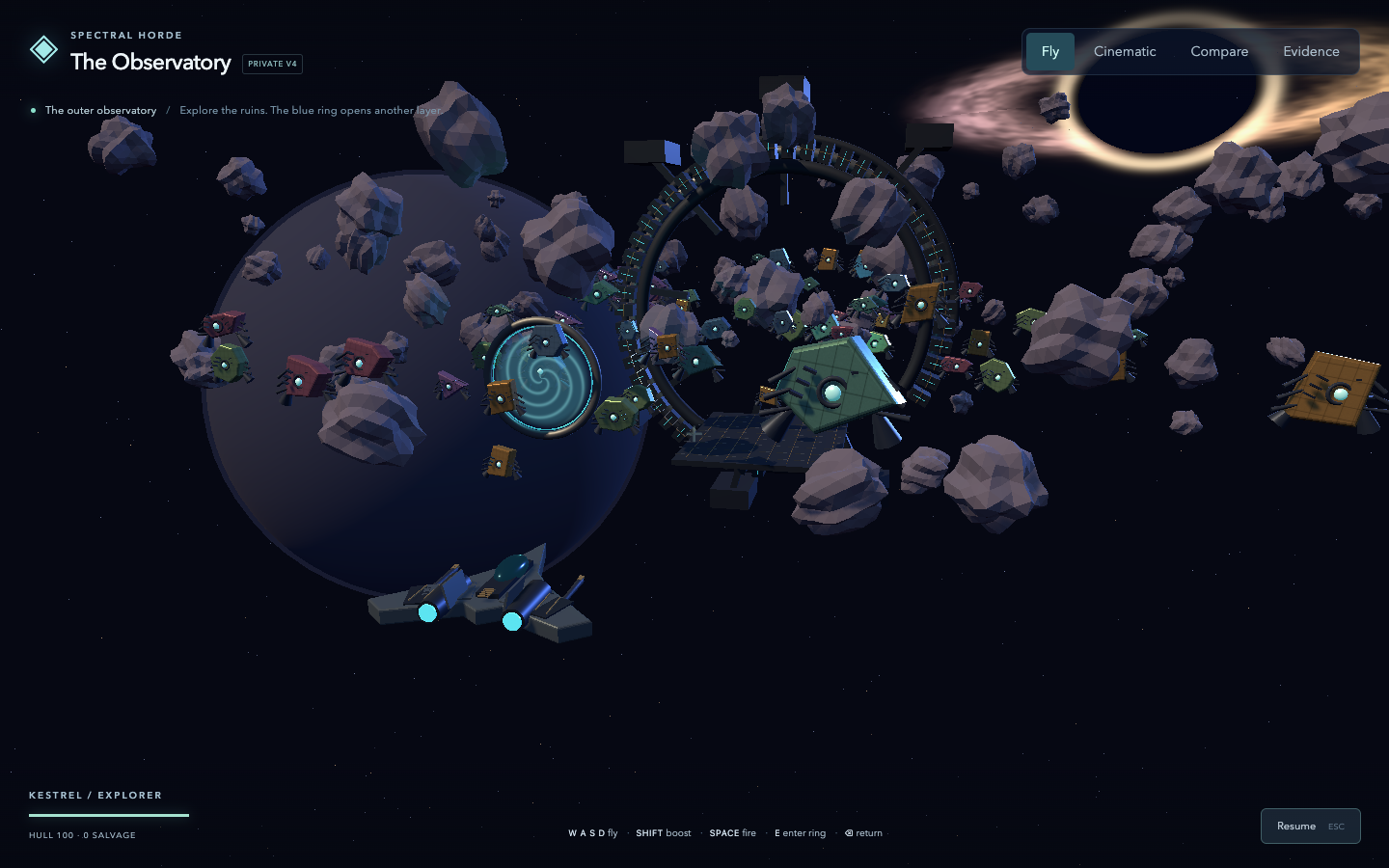
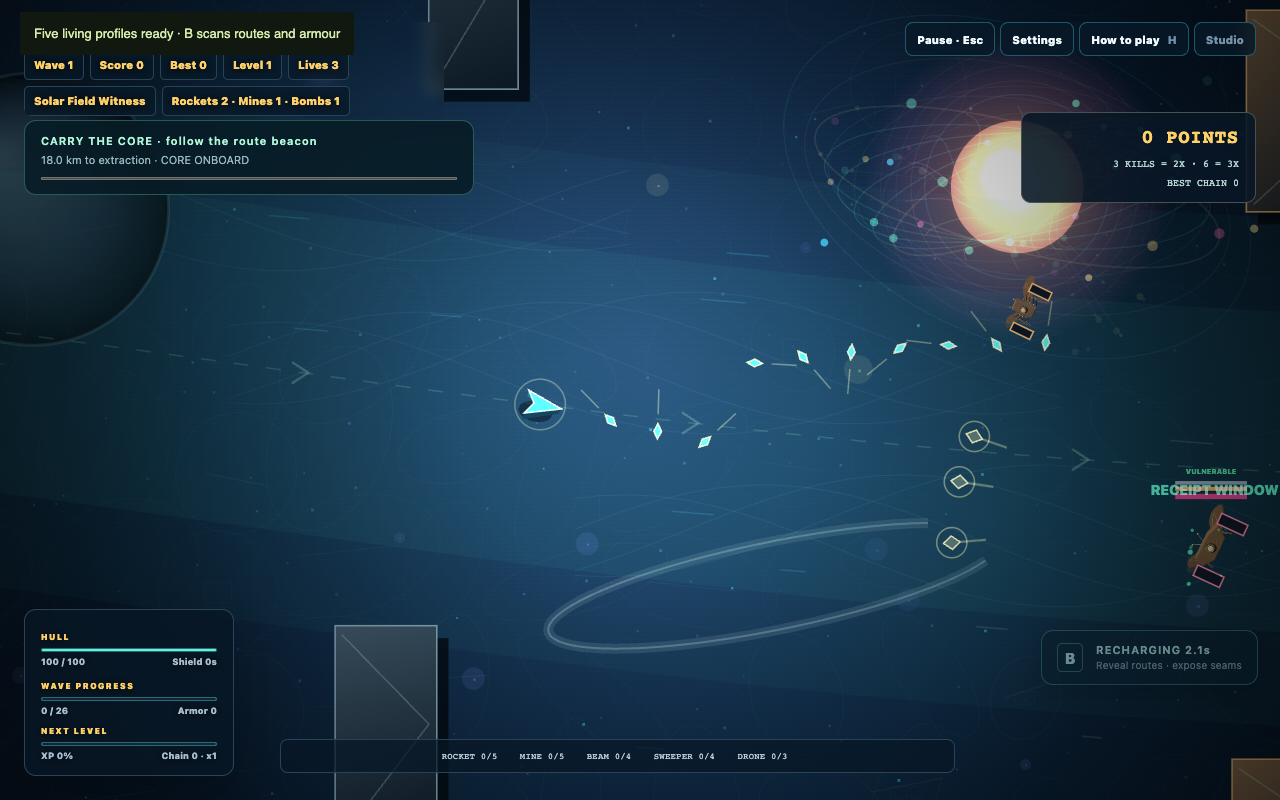
Explore the worlds we have built—from a navigable 3D space scene to a playable mission with changing routes and enemy formations.
WHAT THE WORK SHOWS
Across two finite test worlds run for 1,800 steps each, all eight selected checkpoints were restored exactly. In a separate compatible-content study, the native packet averaged 462 bytes versus 3,117 bytes for the independent compact comparator, with 48/48 rendered-frame matches across eight sessions. The installed runtime, libraries and shared content were outside the packet count.
PUT IT TO WORK
For games, simulation and digital twins, explore more varied content and lighter compatible updates: reuse shared structures and reconstruct the scene, object or view the interaction needs. Evaluate the complete retained size, receiver work and visual output on your target platform.
Study details and comparisons ↓TEST RESULTS & TECHNICAL NOTES
Review the recorded tests, comparison methods and application-specific evaluation questions.
| World-state checkpoint study | Recorded result |
|---|---|
| Selected checkpoints restored exactly | 8 / 8 |
| Finite test worlds | 2, each run for 1,800 steps |
| Narrow recipe-only byte saving | 99.05% |
| Total saving with the same shared basis | 0.55% |
The compact recipe and the total retained system are different storage boundaries. These results concern selected finite checkpoints, not a whole game, unlimited worlds or a production multiplayer service.
| Separate graphics-content study | Recorded result |
|---|---|
| 8 test sessions · 48 of 48 compared frames matched | 8 / 48 of 48 |
| Mean independent compact stream | 3,117 bytes |
| Mean native packet | 462 bytes |
| Mean expanded content represented | 531,278.5 bytes |
| Expanded-content byte avoidance | 99.913003% |
| Reduction versus independent compact stream | 85.18% |
The world-state study measures checkpoint reconstruction with required shared dependencies. The separate graphics-content study is not a qualification of the complete Expanding Worlds architecture. Two later complete-verification workflows took about 1.47× and 1.64× as long as their conventional comparators; these are not game frame-rate timings.
REQUEST A DEMO OR PAID EVALUATION
Tell us about the world you want to build and the engine or platform you use. A paid evaluation can compare state updates, visual fidelity, memory and processing cost with your current approach.